Vaccine for Pancreatic Cancer
English
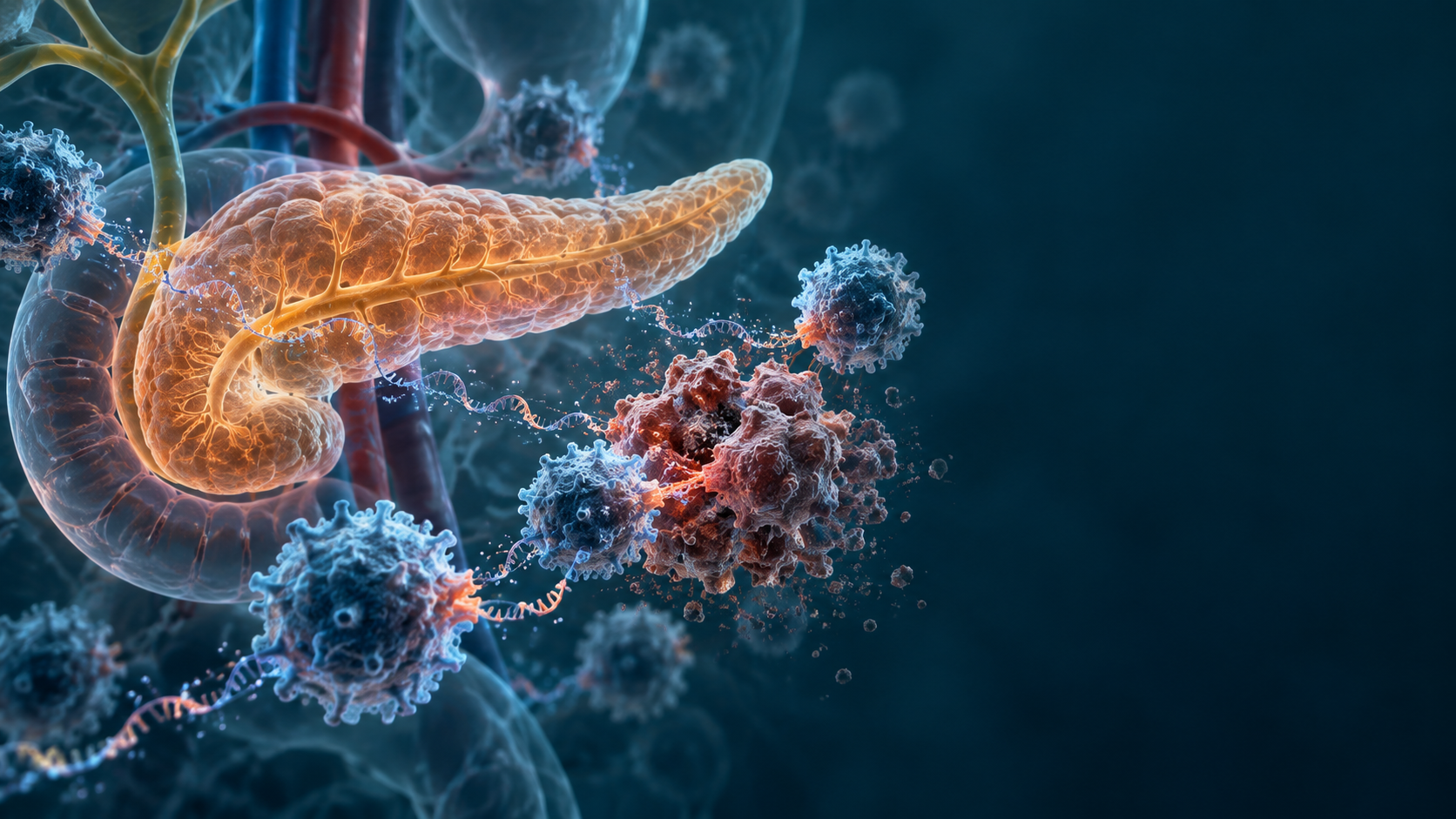
Scientific illustration of a pancreas, immune cells and tumour targets

A new frontier, with evidence still developing

Vaccine for
Pancreatic Cancer

Can the immune system be trained to prevent pancreatic cancer, eliminate microscopic disease after surgery, or delay recurrence?

Current positionNo pancreatic cancer vaccine is yet approved. Human trials are testing both postoperative treatment and prevention in selected high-risk people.
16vaccinated patients in the published personalised mRNA phase 1 cohort
8developed high-magnitude vaccine-induced T-cell responses
3.2 yearsmedian follow-up in the extended report
Phase 2randomised testing is underway after surgery

What has actually been shown?

Promising immune responses, not proof of cure

The central evidence comes from a small, single-centre phase 1 study. Its job was primarily to establish feasibility, safety and immune activity.

Human phase 1

Personalised mRNA vaccine after surgery

Tumours removed at surgery were sequenced to identify mutations unique to each patient. An individual mRNA vaccine encoding up to 20 neoantigens was manufactured and given with atezolizumab, followed by mFOLFIRINOX chemotherapy.

Eight of 16 vaccinated patients developed strong vaccine-specific T-cell responses. At 3.2 years, median recurrence-free survival had not been reached in immune responders, versus 13.4 months in non-responders.

Why this is not efficacy proofResponders were compared with non-responders inside a very small non-randomised cohort. The treatment combined vaccine, checkpoint immunotherapy and chemotherapy. A randomized comparison is needed.

Three different goals

“A pancreatic cancer vaccine” can mean very different things

The expected benefit, trial design and acceptable uncertainty change with the clinical setting.

01

Prevent cancer before it starts

Experimental immune-interception vaccines target shared driver mutations, such as mutant KRAS, in people with inherited risk and pancreatic abnormalities. A 20-person Johns Hopkins phase 1 study produced immune responses in 18 participants, but has not shown that cancer incidence is reduced.

High-risk KRAS vaccine study
02

Prevent recurrence after surgery

Personalised vaccines use the removed tumour to choose neoantigens. This may be an ideal biological window: the visible cancer is gone, disease burden is low, and the immune system may be trained to find microscopic residual cells before they seed local or distant recurrence.

Review the phase 1 signal
03

Treat advanced disease

Established pancreatic tumours create a dense, immunosuppressive microenvironment. Vaccines, checkpoint inhibitors, stromal strategies and other immune combinations are being studied, but immunotherapy works routinely only for small biomarker-defined subsets.

Immunotherapy for pancreatic cancer

Risk reduction is never a guarantee. A preventive vaccine may lower the chance of developing cancer without eliminating it. A postoperative vaccine may lower recurrence risk without preventing every local recurrence or metastasis. Surveillance and symptom assessment remain necessary.

Pancreatic cancer is not one disease

The vaccine evidence is mainly about ductal adenocarcinoma

A pathology label matters. Different pancreatic tumours arise from different cells, carry different mutations, behave differently and may require different trials.

Most common

Pancreatic ductal adenocarcinoma (PDAC)

About nine in ten exocrine pancreatic cancers are ductal carcinomas. The published personalised mRNA vaccine study and its randomized successor concern resected PDAC. Adenosquamous, undifferentiated and carcinomas arising from IPMN or mucinous cystic neoplasms are related but distinct pathological categories.

Different disease family

Pancreatic neuroendocrine neoplasms

Pancreatic neuroendocrine tumours and high-grade neuroendocrine carcinomas arise from hormone-producing cells. Grade, differentiation and hormone production shape treatment. PDAC vaccine results should not be assumed to apply.

Rare exocrine tumour

Acinar-cell carcinoma

Acinar cancers arise from enzyme-producing cells and have a different molecular profile. Surgery, chemotherapy, targeted options and trial selection may differ from PDAC.

Rare and often younger

Solid pseudopapillary neoplasm

This uncommon tumour often affects younger women and generally has lower malignant potential than PDAC. Surgery can be curative in many cases; a PDAC vaccine narrative is not appropriate.

Very rare

Pancreatoblastoma and other entities

Pancreatoblastoma occurs mainly in children. Mixed acinar-neuroendocrine tumours, cystadenocarcinomas, primary pancreatic lymphoma and metastases to the pancreas require specialist pathological review.

Not every mass in the pancreas is pancreatic adenocarcinoma. Treatment and vaccine relevance begin with expert imaging, tissue diagnosis when appropriate, and specialist pathology. Ovarian germ-cell and sex cord-stromal tumours are separate ovarian tumour families, not usual pancreatic cancer categories.

NCI pancreatic cellular classification

Where vaccines fit

Vaccination does not replace standard pancreatic cancer care

Management depends on resectability, spread, tumour biology, performance status and patient goals.

Resectable

Surgery offers the principal chance of cure. Chemotherapy before or after surgery is standard in suitable patients. Vaccine trials are an additional research strategy, not a substitute.

Borderline or locally advanced

Multi-agent chemotherapy, sometimes with radiation, may control disease or make surgery possible in selected people. Clinical trials can test new local, targeted and immune combinations.

Metastatic

Systemic chemotherapy remains central. Germline and tumour testing may identify uncommon targeted or immunotherapy options. Symptom control and supportive care should begin early.

Why tumour and inherited testing matter

BRCA1/2, PALB2 and other inherited variants can affect family counselling and sometimes treatment. Rare MSI-high or mismatch-repair-deficient tumours may respond to checkpoint inhibition. KRAS subtype and other tumour alterations can determine trial eligibility.
The early-detection problem

Too often found after surgery is no longer possible

Early pancreatic cancer may cause no clear symptoms. Tumours can spread while still small, and the pancreas lies deep in the abdomen. There is no recommended population screening test for average-risk adults.

Signs not to ignore

  • Yellow skin or eyes, dark urine, pale stools or persistent itching
  • Persistent upper abdominal pain, sometimes radiating to the back
  • Unexplained weight loss, appetite loss, fatigue or nausea
  • New or unexpectedly worsening diabetes, particularly with weight loss
  • Unexplained pancreatitis or persistent digestive change

Jaundice needs prompt assessment. A tumour in the pancreatic head may obstruct the bile duct, but gallstones, hepatitis and other conditions can cause the same sign.

High-risk surveillance

Screening is selective, not population-wide

Specialist surveillance may be considered for defined high-risk groups, preferably through experienced programmes and registries.

Who may qualify?

People with particular pathogenic variants or syndromes, strong familial clustering, hereditary pancreatitis, or selected pancreatic cystic lesions may qualify. A single affected distant relative usually does not create the same level of risk.

What is used?

MRI/MRCP and endoscopic ultrasound are commonly used in expert programmes. The aim is to identify high-grade precursor lesions or early, resectable cancer while limiting unnecessary surgery.

What is uncertain?

Intervals, starting ages and thresholds differ by gene, family history and lesion. Surveillance can generate incidental findings, anxiety, repeated procedures and operations for lesions that might never progress.

NCI: outcomes from high-risk surveillance

Clinical trials

Ask the treating team early

Eligibility may depend on timing around surgery, tissue availability, stage, previous chemotherapy, inherited variants, tumour mutations and location. Trial status changes frequently.

Connected evidence guides

One question often leads to another

Evidence policy

Primary research before publicity

Evidence labels reflect trial phase and design, not excitement. Company announcements can identify programmes but cannot establish benefit.